CeraVe has been owned by L’Oréal since March 2017, the date of completion of the acquisition from Valeant for $1.3 billion. Understanding who owns CeraVe, what its formulas contain, and what its active ingredients actually provide helps to distinguish between marketing and formulation reality.
MVE Technology and Extended Release of CeraVe Ceramides
The MultiVesicular Emulsion (MVE) is the technical foundation of the entire range. This encapsulation system organizes the moisturizing actives in concentric layers, allowing for a gradual release over several hours rather than an immediate release upon application.
The ceramides and lipids are trapped in nested vesicles. Each layer degrades progressively upon contact with the skin, ensuring a continuous supply of agents that restore the skin barrier.
This mechanism distinguishes CeraVe from traditional instant-release moisturizers. The MVE architecture has direct consequences on daily use, particularly regarding the frequency of application needed to maintain a good level of hydration. An article detailing the owner and composition on Fusion Business revisits the fundamentals of this formulation architecture.
Composition of CeraVe Moisturizing Cream: Ceramides, Hyaluronic Acid, and Niacinamide
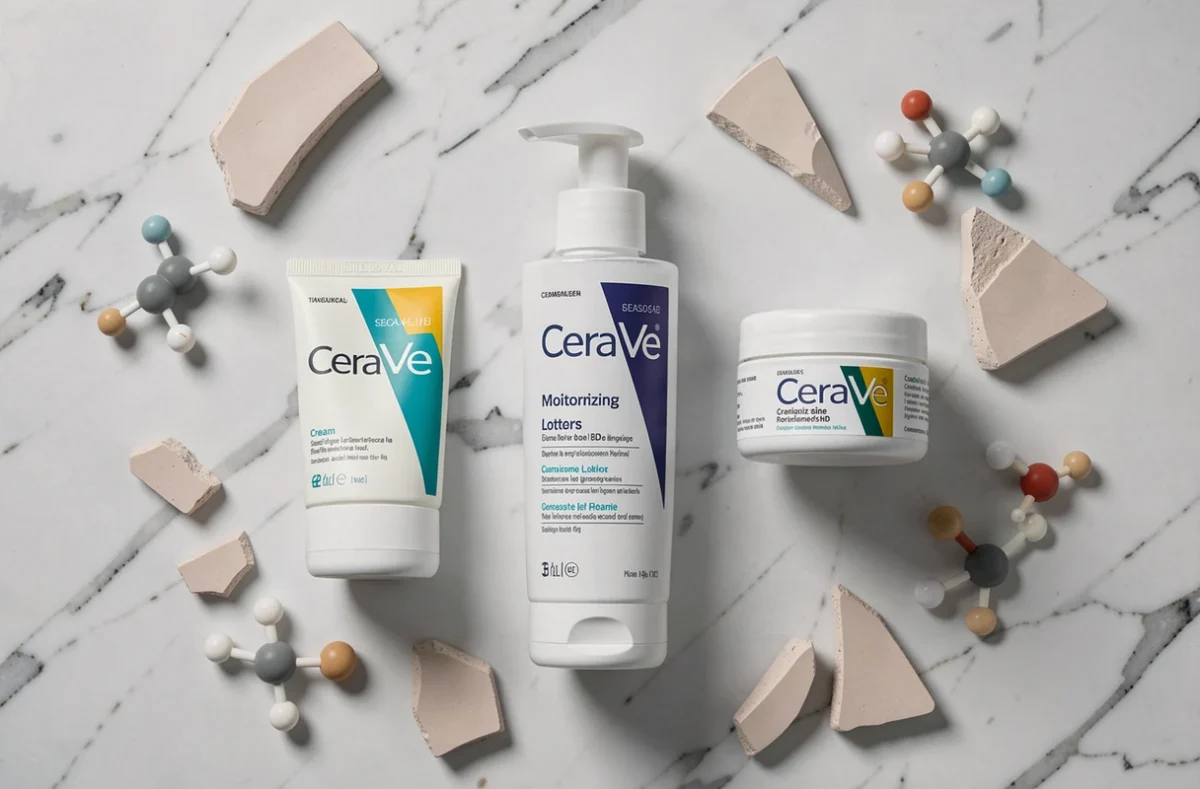
The Moisturizing Cream, the flagship reference of the brand, combines three families of actives that we find in almost the entire range.
- Three ceramides (Ceramide NP, Ceramide AP, Ceramide EOP): these lipids, identical to those naturally present in the stratum corneum, strengthen the skin’s barrier function. Their combination aims to restore the intercellular lipid matrix.
- Hyaluronic acid: a reference humectant, it captures water in the upper layers of the epidermis. CeraVe systematically uses it in conjunction with ceramides to combine superficial hydration with deep repair.
- Niacinamide (vitamin B3): this active ingredient contributes to the synthesis of endogenous ceramides and has soothing properties. Its integration aims to support the natural restoration of the skin barrier over the long term.
The Moisturizing Cream is formulated without fragrance. This minimalist positioning reduces the risk of sensitization, a criterion particularly valued in dermatology for reactive or atopic skin.
What the INCI List Reveals About Tolerance
Independent organizations like Que Choisir evaluate CeraVe products in terms of undesirable substances. The iconic moisturizing cream is not among the formulas flagged for controversial ingredients.
The absence of fragrance and common contact allergens places it in a category of high tolerance. We recommend systematically checking the INCI list of the purchased product: formulations vary from one reference to another within the range.
Proven Benefits of CeraVe on the Skin Barrier
The combination of exogenous ceramides and a powerful humectant produces two measurable effects: the reduction of transepidermal water loss (TEWL) and the increase in stratum corneum hydration. These are the objective markers used in clinical studies to assess the effectiveness of a moisturizing treatment.
CeraVe targets the functional restoration of the barrier, not just cosmetic comfort. A classic emollient softens the surface. Ceramides, on the other hand, rebuild the intercellular lipid matrix. The benefit may persist after discontinuation of the product, unlike a simple occlusive film.

Dry Skin, Eczema, and Atopic Dermatitis
CeraVe was developed in collaboration with dermatologists, with a strong focus on atopic-prone skin. The ceramide-niacinamide combination aims to rebuild a deficient barrier, a common characteristic of eczema and atopic dermatitis.
The fragrance-free formulation and physiological pH limit irritation factors. For patients undergoing dermatological treatment (topical corticosteroids, immunomodulators), CeraVe Moisturizing Cream frequently serves as a supportive treatment between active phases of therapy.
Benzene and Benzoyl Peroxide Controversy: What Really Concerns CeraVe
In March 2024, the Valisure laboratory reported to the FDA a risk of benzene formation in certain products containing benzoyl peroxide exposed to high temperatures. The CeraVe products involved were the 4% Acne Foaming Cream Cleanser and the 10% Acne Foaming Cream Wash, two specific anti-acne references.
The Moisturizing Cream, Foaming Gel, and Hydrating Lotion are not affected by this alert. No CeraVe recall has been identified in the results published by the FDA at the time of this analysis.
Legally, a U.S. federal court decision in September 2026 dismissed with prejudice the class action against L’Oréal. The court found that federal regulations governing over-the-counter drug labeling prevailed over the warning obligations invoked. The documented health risk remains limited to benzoyl peroxide formulas exposed to heat, a scenario distinct from the daily use of a moisturizer stored at room temperature.
For users of the moisturizing range, this controversy does not call into question the safety of the flagship products. We recommend storing any benzoyl peroxide product away from heat and checking expiration dates, in accordance with general FDA recommendations for this category of actives.