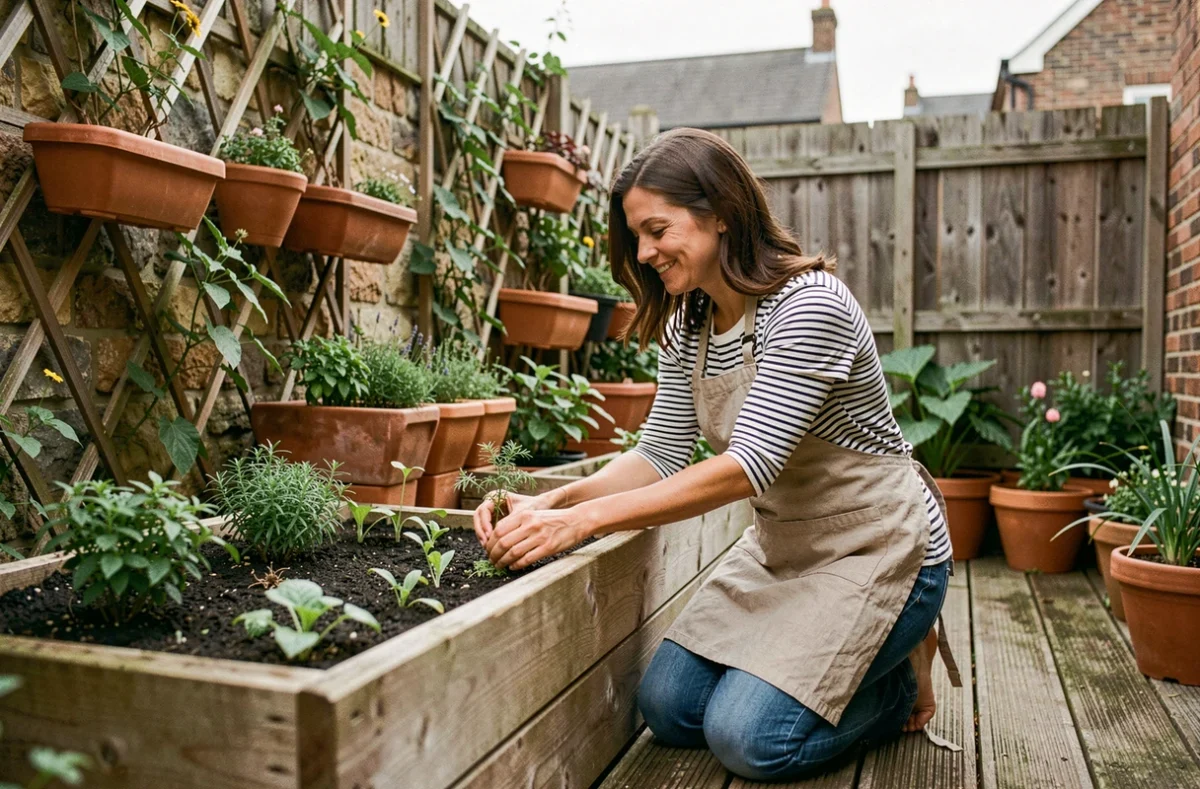
A 40 m² garden in the city, wedged between a party wall and a concrete terrace, is not designed like a 500 m² plot in a rural area. The constraint of space changes everything: the layout of pathways, the choice of plants, the management of water. Optimizing your garden means first accepting to give up certain areas to make others truly functional.
Permeable soil and water management: the foundation of an optimized garden
We rarely start here, and that is a mistake. Before thinking about plants or furniture, one must look at the soil. A garden with a large part sealed (jointed slabs, concrete, compacted gravel on geotextile) loses most of the rainwater through runoff.
Local authorities now encourage the infiltration of water as close to its fall as possible, using draining pavers, cobblestones, or grassy surfaces. This approach reduces runoff, creates cool spots, and preserves soil life. In a small garden, space is saved by combining pathways and infiltration: a path made of Japanese stepping stones laid on non-compacted gravel serves both functions.
Combining these permeable surfaces with a rainwater collector allows for watering without tapping into the network. You can also find tips from L’Herbe sous le Pied on this topic, with concrete ideas for linking landscaping and water savings.
Dry garden and xeriscaping: reducing lawn to gain space
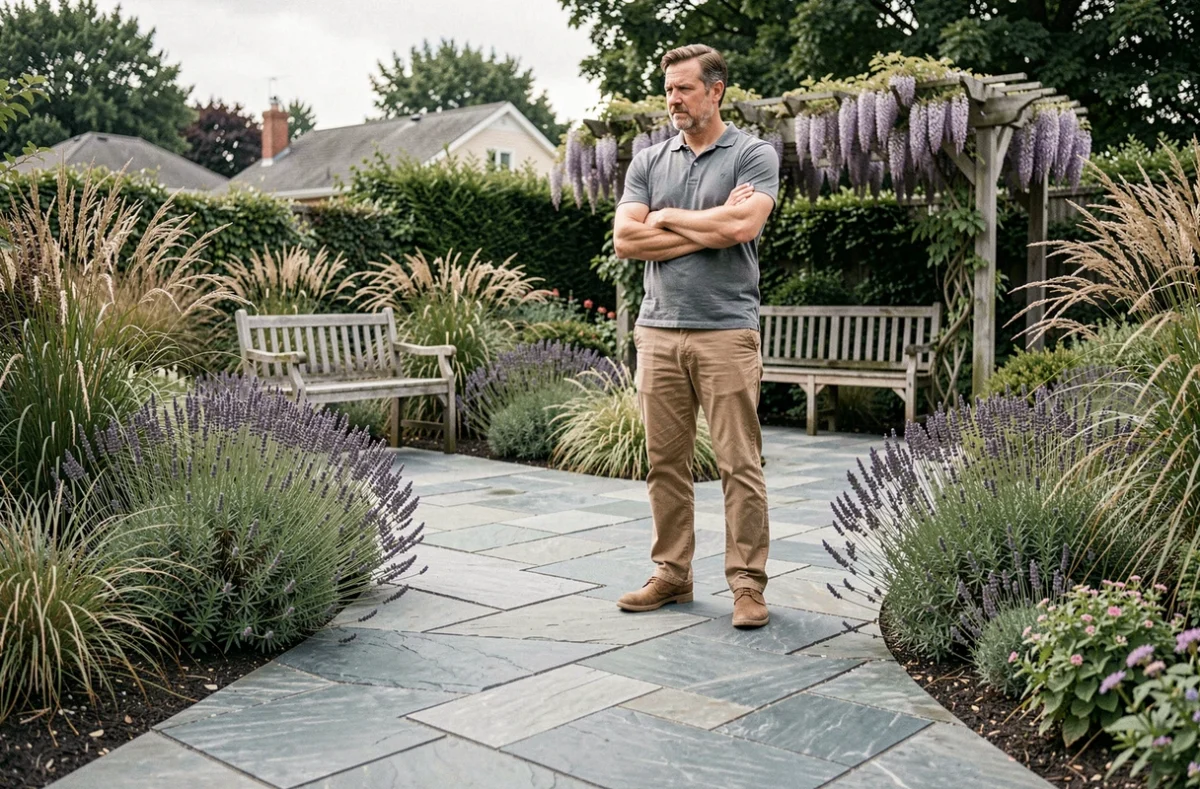
The lawn takes up space, requires water, mowing, and does not add much to a small garden. Recent practices recommend reducing grassed areas to the strict minimum and replacing them with suitable ground covers or beds of drought-resistant plants.
Xeriscaping is based on a simple principle: grouping plants according to their water needs. The most water-hungry plants are placed near the water source or downspout, while drought-tolerant species (lavenders, grasses, sedums) are positioned in the sunniest areas.
Organic mulching to limit maintenance
Mulching plays a dual role in an optimized garden. It limits evaporation and reduces weeding, freeing up time and visual space. A well-mulched bed looks neater than a hand-weeded flower bed, and it gradually improves soil structure.
Opinions vary on the ideal thickness depending on the type of mulch (wood chips, pine bark, hemp flakes), but the principle remains the same: cover bare soil wherever there is no traffic.
Vertical zoning and plant layers in a small outdoor space
When ground space is lacking, we work upwards. Three layers are enough to give depth to a narrow garden:
- The lower layer: ground covers, creeping perennials, herbs at the edges. They dress the base of walls and fences without encroaching on pathways.
- The middle layer: compact shrubs (euonymus, pittosporum, abelia) pruned for transparency to let light through while filtering views.
- The upper layer: one or two small-growing trees (Japanese maple, Judas tree) whose canopy creates shade without suffocating the rest of the garden.
This principle of layering plant strata effectively replaces the monospecific hedge, which consumes a lot of width on the ground for often monotonous results. In a long garden, alternating heights breaks the perspective and gives the impression of successive spaces.
Creeping plants and green walls
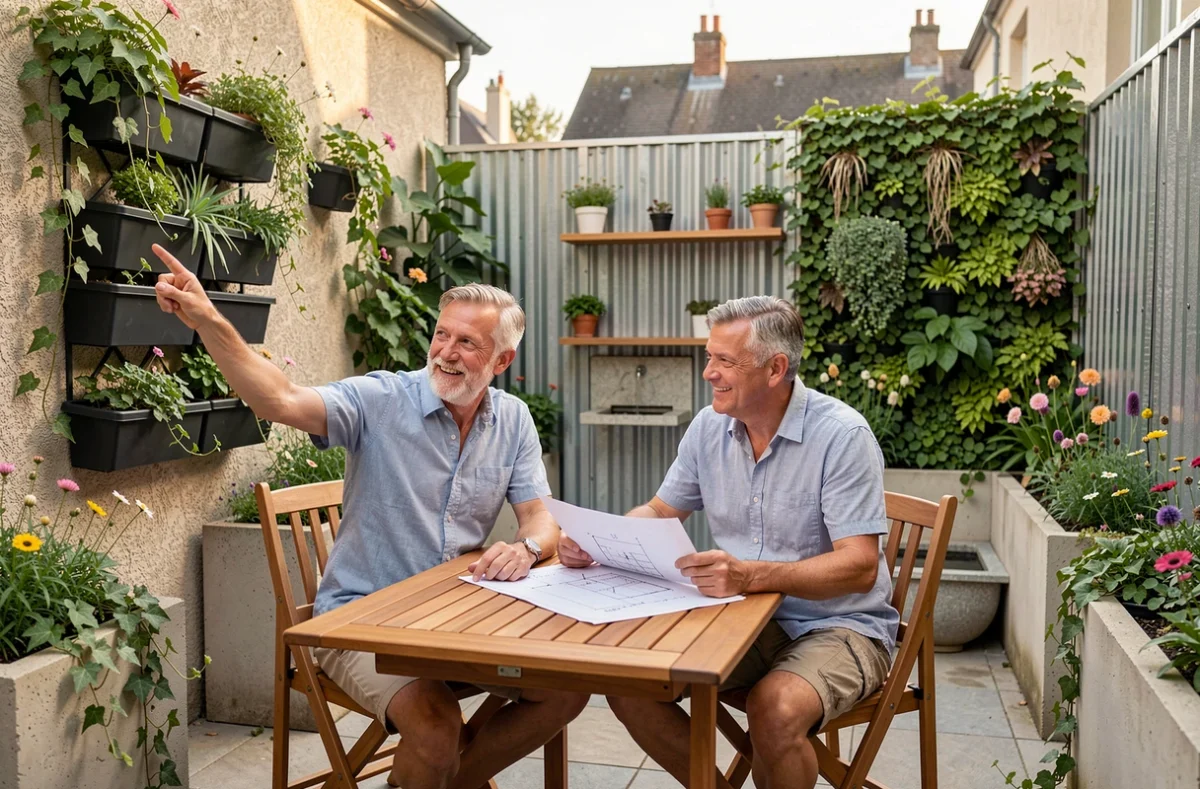
A bare wall two meters high represents several square meters of usable surface. Star jasmine, honeysuckle, clematis, or virgin vine transform an unsightly wall into a green screen without encroaching on the ground. A trellis or a taut cable is fixed a few centimeters from the wall to allow air circulation behind the foliage.
For very mineral balconies or courtyards, vertical planters allow for the installation of herbs or small perennials in less than 30 cm of depth. Every square meter of green wall frees up as much ground space.
Balancing biodiversity and maintenance in an urban garden
The temptation in a small space is to plant densely to achieve a lush effect quickly. The problem arises two or three years later when the plants compete, pruning becomes time-consuming, and pathways disappear under the vegetation.
Better results are obtained by limiting the number of species and choosing plants that naturally combine. A bed of three well-associated species (a grass, a flowering perennial, a ground cover) requires fewer interventions than a mix of eight species with different needs.
- Favor local or adapted species to the soil and climate: they resist better and require less watering once established.
- Accept a degree of spontaneity: allowing a few plants to settle naturally between the slabs or at the foot of walls contributes to biodiversity effortlessly.
- Reserve a small patch of bare soil or dead wood for beneficial insects, even in a small space.
Biodiversity in an urban garden does not require surface area; it requires diversity of micro-habitats: a pile of stones, a wet area in a dish, a thick mulch under a shrub.
The trap of an overly decorative garden
Highly mineral designs (white gravel, pebbles, Japanese stepping stones on tarpaulin) are appealing in photos but pose concrete problems. White gravel gets dirty quickly, tarpaulin prevents water infiltration, and creates heat pockets in summer. Mixed solutions are often revisited: local crushed gravel without tarpaulin, interspersed with ground-covering plants.
A garden that works over time integrates life into every area, including pathways. It is this approach that allows one to get the most out of a limited outdoor space without multiplying maintenance chores.