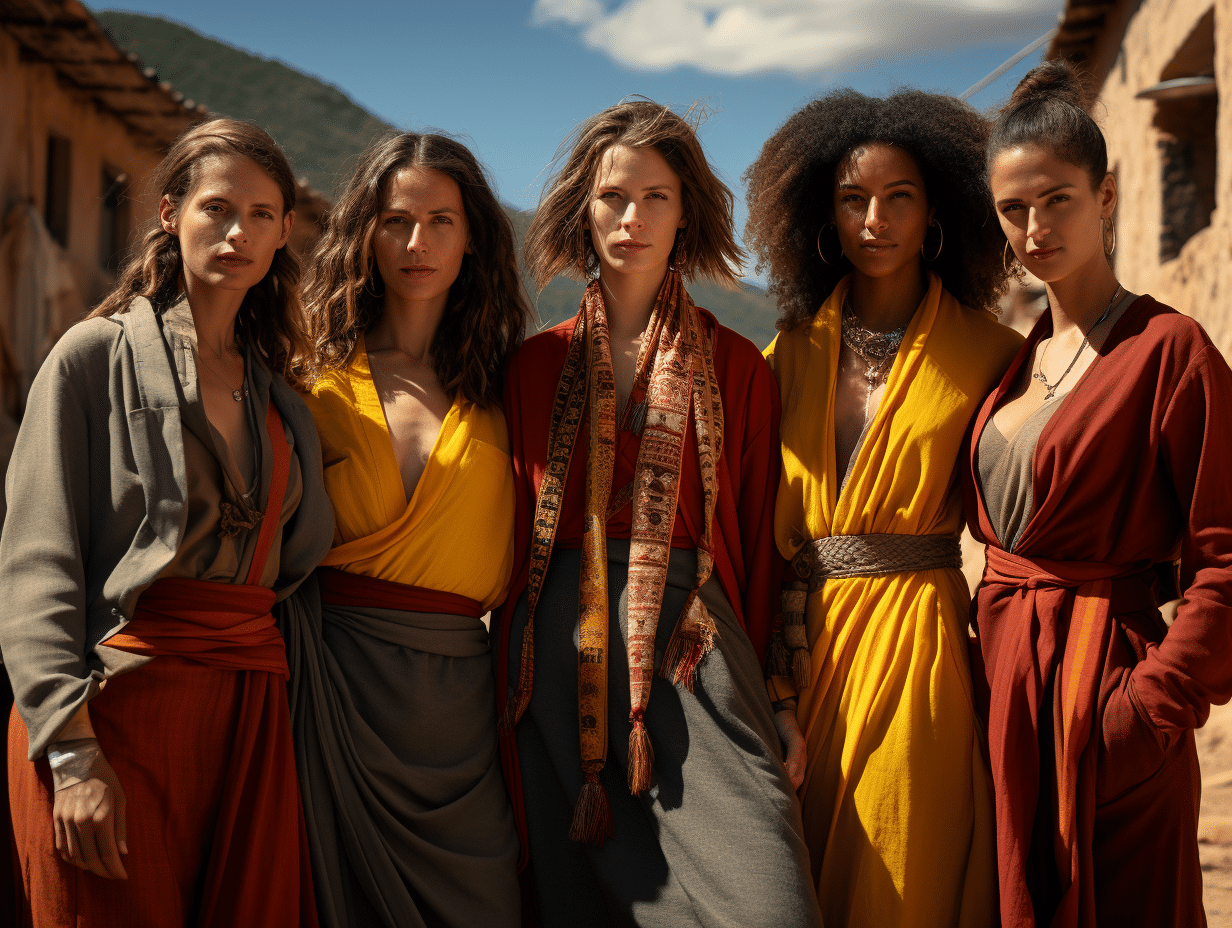
Fashion transcends its primary function of covering the body to become a means of expressing personal identity. This complex link between the clothes one chooses to wear and the self-image one wishes to project is woven with social, cultural, and psychological nuances. Colors, cuts, textures, and accessories are all vocabularies used to tell a personal story, communicate status, display belonging, or assert difference. In this intertwining of threads, each person becomes both creator and bearer of their own identity brand.
Fashion as an Expression of Personal Identity
Orvinfait, the concept of personal identity is a continuous construction, shaped by the interactions and encounters of each individual. It is Erving Goffman, a renowned sociologist, who theorized the idea that identity is formed and revealed in social interaction, with clothing never being neutral but always carrying signs. Consider dress codes as a stage where a play is performed daily, with actors, whether aware or not, taking on roles defined by their attire.
The philosopher Emmanuel Lévinas, for his part, conceptualized identity as emerging from the encounter with the other, an original experience that reveals subjectivity. Fashion, in its most singular form, can be seen as an extension of the Lévinasian Face, a means for the person to present themselves to others, to initiate a dialogue without words, and to mark their uniqueness.
The face, in the Goffmanian sense, is a key component of identity: it is the presentation of self in interaction, a sacred surface whose loss can signify a challenge to the individual’s identity. Fashion fits into this logic of presentation and identity recognition, where the choice of a garment or style carries within it the seeds of self-affirmation or self-protection.
These clothing interactions, far from being trivial, contribute to the formation of identity of the person. It is a process where the individual, through their aesthetic choices, engages in a dialogue with society, seeking to find their place, to be recognized, and to assert their uniqueness. Fashion, in this perpetual exchange, becomes a complex and subtle language of personal identity.

The Reciprocal Influences Between Fashion and Self-Construction
In the wake of Georg Simmel’s reflections, the role of fashion in the construction of personal identity proves inseparable from social order. Simmel, by theorizing the intersection of social circles, highlighted the individualization emanating from the plurality of belongings and affiliations. Fashion sits at the intersection of these circles, being both a social role assumed and an individual choice, revealing the constant interaction between the individual and collective norms.
The social role, as Simmel emphasizes, manifests in interaction and can influence or determine the identity of the individual. In this context, fashion and clothing appear as key elements of social performance. They can be perceived either as markers of belonging to a group or as tools of distinction. Fashion thus becomes a complex language through which the individual communicates their identity, either conforming to or opposing the established social order.
The Milgram Experiment, by demonstrating individuals’ tendency to obey authorities even in contradiction to their own values, questions the strength of identity in the face of imposed roles. In the realm of fashion, this translates into the potential conflict between the individual’s desire to express themselves and the expectations of conformity. Fashion can be a form of resistance, a means for the individual to maintain their identity in the face of normative pressures.
Fashion and social life are thus intimately linked, the former being a vector of social integration but also of differentiation. It contributes both to the expression of personal identity and to the formation of social order. Dressing, in its most everyday dimension, thus becomes an act laden with meaning, a choice that engages the individual in the social process of identification and recognition.